The Strategic Convergence: How Sports and Card Games Are Merging in 2026
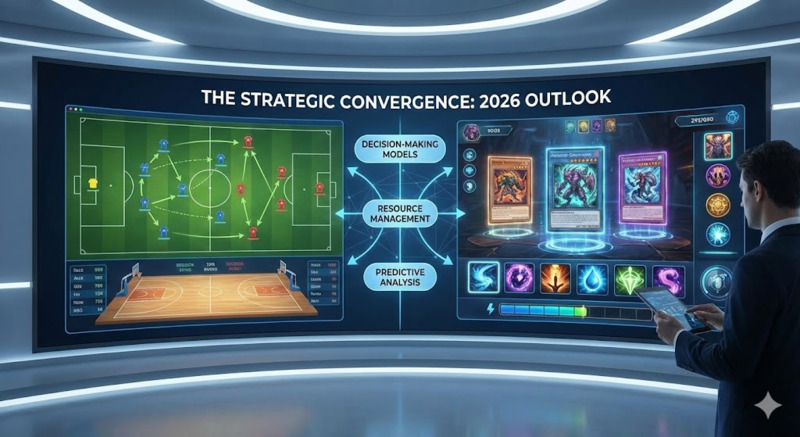
Image Credit - Gemini
By 2026, the centuries-old difference between the athlete and the card player is officially dead.
Over the decades, we have considered sports as a field of physical power and card games as a field of intellectual deception. However, with a year that has been marked by the complete datafication of competition, those boundaries have become blurred. This is like a quarterback scanning a defense or a card counter scanning a blackjack shoe, but what is important is that the fundamental field is the same: high-frequency decision-making under uncertainty.
The article examines a phenomenon known as the Strategic Convergence- when the mathematical precision of the casino has infiltrated into the office of the General Manager, and the physical discipline of the elite sportsman has revolutionized the professional gambler. Through a comparison of the common structures of Expected Value (EV), risk management, and neurobiology, we can see a cohesive ecosystem of competitive entertainment.
1. The Mathematics of Advantage: Expected Value (EV) Everywhere
This convergence is based on a mathematical basis. The era of romance in sports, built on gut feeling, is over, and in its place is the inflexible framework of probability theory that has been overseeing the blackjack and poker tables.
The EV Engine
EV is defined as the amount that a player is going to win or lose, on average, every time they place a bet in a strategy game such as blackjack. The professional gamblers do not gamble; they only invest when the EV is positive. In blackjack, a True Count of +4 produces a mathematical advantage of approximately 2% to the player, which is worth betting a lot.
This exact calculus is used to make all the play calls in the NFL and NBA in 2026.
- The 3-Point Revolution: The fact that an NBA team chooses to value 3-point shots is a direct application of EV. A deep 35 percent shooter is worth 1.05 points per possession, compared to a 45 percent mid-range shooter who is only worth 0.90 points.
- Fourth Down Logic: Real-time analytics allow NFL coaches to compute the EV of going for it on fourth down, taking into account granular variables like wind resistance and fatigue of the opponent.
Similar to a blackjack player who will hit 16 when the dealer has 7 to avoid losing more, a football coach will make statistically optimum choices that will appear risky to the layman, but to the mathematician, it is necessary to win in the long run.
Managing Variance and the "Long Run"
Both disciplines have to struggle with Variance- the difference between the anticipated outcome (luck). There are blackjack players who can play perfectly and still lose because of an unfortunate streak of playing cards. Equally, a soccer team could have an Expected Goals(xG) of 2.5, but still lose 1-0.
Volume is the contemporary remedy in both fields.
- Casinos: Millions of hands are grinded by players so that there is convergence between results and EV.
- Leagues: Formats of sport have been diversified (e.g., best-of-seven series) to minimize the chances of variance defining the champion.
2. Risk Management: The Kelly Criterion in the Front Office
The universal adoption of the Kelly Criterion is, perhaps, the most advanced connection between Wall Street, Las Vegas, and the Front Office. This formula was created in 1956, and it is used to calculate the best bet size to maximize wealth without being ruined.
From Bankroll to Salary Cap
The Kelly formula used in the casino states that a player should bet more when he or she has a greater advantage. When you have a lot of Aces in the deck, you bet large. You bet the minimum in case the house has the edge.
Salary Cap is the bankroll in professional sports management.
- The "Max Contract" as a Kelly Bet: Signing a superstar quarterback to 25% of the salary cap is a "Kelly bet." It is a massive allocation of resources based on a high probability of production and a high return on investment.
- Avoiding "Bad Money": Conversely, GMs use Kelly logic to avoid overpaying for low-leverage positions. Allocating 15% of the cap to a declining veteran is a mathematical error equivalent to over-betting a negative count in blackjack.
The Portfolio Approach
In 2026, a standardized approach to a portfolio of bets is in place. Teams spread their risks by investing in a variety of assets (players) of median value as opposed to taking a gamble on one high-risk variable. This corresponds to the behavior of a professional gambler who bets on several hands to reduce volatility and avoid a complete wipeout.
3. The Psychology of Elite Performance: Flow and Tilt
Outside of the math, the neurobiology of high-stakes settings is the same. The brain is not able to tell the difference between scoring a touchdown and drawing a huge pot in poker; both of them cause a dopamine release in the ventral striatum.
The Neurochemistry of the "Rush"
Top players in the two industries demonstrate sensation-seeking characteristics but have better inhibitory powers. They are not in pursuit of risk excitement; they are after mastering the art of risk. Nevertheless, this mutual chemistry generates mutual weaknesses. Athletes have a much higher risk of falling prey to gambling disorders compared to the rest of society since they are accustomed to their brains being trained to deal with high-stakes dopamine loops.
Tilt Control and the "Quiet Eye"
Tilt is a poker term that means to be emotionally aggravated, which lowers the quality of decision-making. Tilt management in 2026 is one of the major areas of sports psychology.
- Loss Aversion: Both gamblers and athletes experience the loss pangs twice the intensity as the win ones, which results in irrational chasing behavior.
- Neurofeedback Training: This is the game-changer of 2026. Now, EEG biofeedback is being used by athletes and poker professionals to train their brains. They are taught to slow down their Theta/Beta ratios, becoming less impulsive and getting into the “Flow State at will.
- The Quiet Eye: Neurofeedback is used in golf and shooting to attain the so-called quiet eye or state of visual fixation that is needed to achieve extreme precision, comparable to that of a card counter who is counting a shuffle.
4. Strategic Frameworks: GTO vs. Exploitative Play
The historical development of sport and games has taken parallel lines: folk wisdom, computer modeling, and, lastly, the hybrid human-AI style.
Game Theory Optimal (GTO)
GTO is a defensive measure aimed at making it unexploitable.
- In Poker: It is bluffing and betting at frequencies such that your opponents are unable to read your hand strength.
- In Sports: It takes the form of play-calling balance. An NFL offense does not always pass 100 percent of the time. In modern analytics, a Solver is used to calculate the Nash Equilibrium for selective play, such that the defense is indifferent to the selection.
Exploitative Play
Whilst GTO avoids losing, Exploitative Play maximizes the winning by targeting certain weaknesses.
- In Blackjack, the act of counting cards is all exploitation. It is only when you know that the deck is weak that you deviate from Basic Strategy.
- In the NBA, when a defender possesses slow lateral movement, an offensive player will seek to exploit the discrepancy, isolating that weak spot again and again.
The 2026 Hybrid Model: The most effective competitors in the modern world employ AI to achieve a GTO baseline, but they use human intuition to break it when they feel that their opponent has a psychological or physical vulnerability.
5. The Panopticon: Surveillance and Data Integrity
This convergence can be seen most in the technology involved in monitoring the games. The stadiums, as well as the casinos, have turned out to be panopticons of data gathering.
Skeletal Tracking and Smart Tables
- FIFA's Skeletal Tracking: During the 2026 World Cup, cameras record 29 data points of each player at a rate of 50 frames per second. This information drives automated refereeing and biomechanical injury prevention.
- Casino Smart Tables: RFID and computer vision are currently used to trace each card thrown and each chip bet. Gestures made by players are analyzed with algorithms that identify card counters or cheating rings.
The Rise of Item-Level Intelligence
We are now in the age of Item-Level Intelligence. From the RFID chip embedded in an NFL football (to monitor the rotation and speed) to the RFID tag in a casino chip of high denomination, all physical objects are networked nodes. Integrity is the force behind this surveillance. As billions of dollars of money pass through these ecosystems, the identification of match-fixing and collusion is of the utmost importance.
6. The Future of Competition: 2026 and Beyond
As we look at the current landscape, the structure of competition itself is changing. There is an increase in the sportification of games and the gamification of sports.
Micro-Betting: The Casinofication of Sports
Micro-Betting is the most disruptive trend of 2026. With 5G/6G low-latency networks, fans can now bet on various micro-events in real-time: Will the next pitch be a ball or a strike? Will the next play be a run or a pass?
This turns a 3-hour baseball match into a sequence of hundreds of instantaneous independent bets. The interaction process of the viewer has now resembled the pace of a blackjack game compared to the storytelling of a conventional match. It forms a continuous dopamine cycle, which effectively changes the consumption nature of sports.
The Mind Sports Movement
At the same time, strategy games have become institutionalized.
- IMSA Recognition: With the establishment of poker as a Mind Sport by the International Mind Sports Association, these games are lobbying to be included in the Olympics.
- Tournament Structures: Blackjack and poker have adopted elimination formats, "duplicate" play (removing luck of the draw), and global ranking systems (GPI) that mirror the ATP tennis rankings.
Conclusion: The Unified Theory of Competition
The merging of sports of a professional nature and strategy card are not merely a surface phenomenon; it is a complete shaking up of the way we comprehend competition.
In 2026, the athlete is a biometrically controlled asset that is controlled through portfolio theory. The card player is a mental athlete who is trained through neurofeedback. Both the casino and the stadium are data capture environments that are highly technological. And overseeing it all is the unyielding logic of mathematics—Expected Value, Variance, and the Kelly Criterion—determining winners and losers with impartial precision.
In this new age, where the game that you are playing with a ball or a hand of cards is irrelevant, the common game of information advantage is what counts.